
ornamental flowers
speculative histories

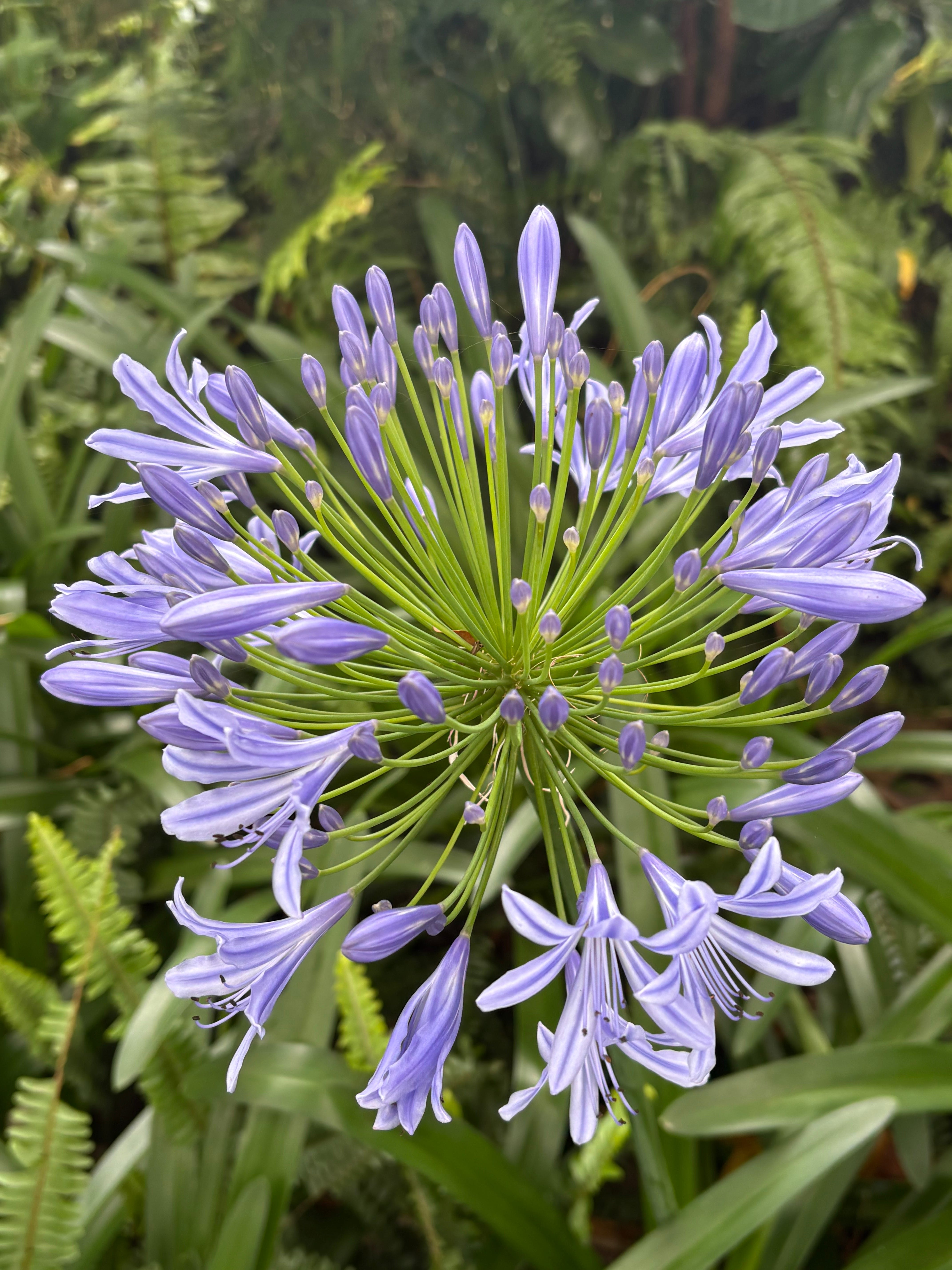
Nairobi is entering agapanthus season, which runs from July through September, sometimes until October. Across the city, swathes of agapanthus bloom in blue and white: swollen green buds perch on stiff stems, opening slowly to reveal tight flower clusters that shift colour from a light green to an almost white and, finally, to a blue or white; only then do the flowers unfurl, and they open from the bottom of the flower cluster to the top, much like snapdragons. From bud to unopened flower might take a few weeks; from unopened flower to fully opened flower might take another few weeks.
Native to South Africa, agapanthus flourishes in Nairobi, and I’ve been wondering how it arrived here. Did it come with the South Africans who moved into British East Africa, joining the British to settle in the highlands?1 In rereading Valentin Mudimbe, I learn that the word colonial comes from the latin root colere, which means to cultivate; as elsewhere in the colonized world, settlers in Kenya built ornamental gardens to remind themselves of their home countries and also to testify to their colonial adventures. They planted English plants, the ones that could survive the tropics, and a host of other plants gathered from other colonial travels.2
Enslaved Africans carried okra, watermelon, black-eyed peas, yam, sorghum, peanuts, and other plants to the Americas. They brought, as well, and perhaps more importantly, cultivation techniques. At the same time, white explorers, traders, and naturists carried plant specimens from their travels, sometimes as preserved samples and other times as live plants, to try in their own climates. I wonder if agapanthus first traveled to the territory that would become Kenya—the first South Africans to arrive here did so before 1920, when the colony was officially named Kenya—through colonial expansion, as part of the ornamental practices of settler colonialism.3
Yet.
I am troubled by my assumption—grounded in trained incapacity—that ornamental plants—even though agapanthus has medicinal uses—traveled through colonialism. I am troubled by my assumption that Africans did not gift and trade beautiful plants as part of their social practices. We know that Africans regularly gifted and traded edible plants, and that knowledge sits within a broader view of Africans as practical rather than imaginative, as craftspeople rather than artists, or, to use a cruder, racist description, as lacking aesthetic sensibilities.4 A colonial lie: white people brought aesthetic sensibilities to Africa.5
Could Africans who migrated from southern Africa have carried ornamental plants to remember their homes? Could agapanthus have traveled along the long eastern African shoreline, from boat to boat, trader to trader, as gift and love object, as medicine and ornamental? A video I watched claimed that European sailors carried the plants home to their loved ones, to share the beauty they encountered during their travels. Is it so difficult to imagine African and Arab sailors, similarly, carrying beauty home to share with their loved ones? What might a speculative history of agapanthus’s travels make possible in how we think about travel and aesthetics and relation and worldmaking?
It took a lot of throat clearing to get to that question: What might a speculative history of agapanthus’s travels make possible in how we think about travel and aesthetics and relation and worldmaking?
*
Agapanthus is both an object of curiosity and a point of departure for a broader set of questions about African relations to ornamental plants. I do not ask the silly question of whether African appreciate ornamental plants. Nor do I want to think of ornamentation as a coincidental attribute of useful plants, such that the beauty of agapanthus or marigolds or tithonia or African daisies is necessarily subordinate to their medicinal properties and ritual uses. I want to sit with the ordinariness of my mother and her friends exchanging cuttings and gifting seeds, of buying planters and creating colourful borders. I want to sit with the roadside nurseries that beautify Nairobi along with the plants grown along the highways and next to kiosks. I want to linger on the a city that goes into a haze of purple during jacaranda season, on the startling beauty of flowering nandi flames, on the lush pink of bombax, and the sweetness of flowering jasmine. I am interested in how to think about Africans as people whose movements across spacetime have always included aesthetic components.
To use a different register: African movement is inextricable from African aesthetics. Tracking ornamental plants across African spaces might tell us something about this relation between movement and aesthetics. I mean aesthetics in a rather ordinary fashion as the imaginative ways in which we create and share beauty. In turning to ornamental plants, I want to shift ground—such extravagant metaphors we use, as though speculative experiments are seismic events—away from the domain in which one must think aesthetics in the modern age beginning with Kant and then moving through a whole bunch of people located, first, in Europe, and then in the Americas. I lack the conceptual tools to translate that work in ways that would be useful to think with my particular geohistory, not to mention, it’s tedious to go through colonial genealogies to arrive at the possibility of thinking about here.6
*
If you harvest seeds from a flower and sow them, there’s no guarantee that the plants will resemble those from which seeds were taken. They might vary in height, vigour, stem thickness, flower colour, seed production, scent, fruit production, resistance to pests and disease, leaf shape, and drought tolerance. A map of ornamental flowers that followed human, animal, and elemental (wind, rain, sand, dust) movements across Africa would be a map of difference, not a clear trail of identical plants, but an unfolding of variation, so much variation, in fact, that to a casual observer, there might be no relation between flowers that come from the same stock. Nature’s aesthetic experiments.
(Plant breeders on YouTube say it can take up to a decade to produce a new, stable plant variety. Stable means that the seeds will produce a fairly reliable type of plant; a seed for a red flower will produce a red flower.)
The type of speculative ornamental map I’m imagining, created by the entangled movements of animals and elements, might provide ways of thinking about ordinary aesthetic practices that nourish us. The glimpse of a flower along a path might cause you to linger, dilate your pupils, create a yearning to stroke petals or draw closer to search for a scent. It might spark a memory of flowers that look similar or inspire a desire to reproduce the colour and shape of the flower. What are dyes made from flower petals but attempts to live as flowers?
I grow interminable.
On reflection, an editor might tell me to reframe this entire thing, and to start with my mother’s practices of growing flowers from cuttings, how she’d collect cuttings from friends and strangers, sometimes taking little bits from plant nurseries and flower shops, how she’d place those cuttings in old metal cans and plastic bottles until they rooted, and then decide whether the new plants should go in pots in front of the house, where she’d always see them, or in gardens that she’d walk around. An editor might tell me to move from my mother to the friends she gifted with cuttings, and even the rude people who took them without asking. From those intimacies, I might then be encouraged to map a broader, speculative geohistory of women’s aesthetic practices around ornamental plants.
I want something more unruly, a way of thinking and feeling through something that sits at the edge of history, that lacks historical significance, being broadly uninterested in questions of power.7 If mapmaking is always political, I want to imagine a kind of mapping that tracks delight rather than power, a mapping of entangled coincidences, where a seed might move with a bird, shift through wind and rain, grow into an object of delight that insects might sip at, and human hands touch. I want the voice that tells another person to watch the bees and wasps as they land and sip and stagger drunk with sweetness, and that knows to leave a flower on a plant so that future bees and wasps might also learn the pleasures of nectar. At the edge of history, the travels of ornamental plants might sing us differently, awaken us to the ordinariness of our worldmaking practices.
A handy footnote tells me: “Two governors, Girouard (1909–12) and Northey (1918–22), had married white South Africans while serving there. Kenya’s chief land surveyor, Arthur Baker, was the brother of Herbert Baker, the architect of union public buildings in South Africa. Christiaan Felling, a South African originally from German South-West Africa, was general manager of Kenya railways from 1922 until his death in 1928.” (Home, “Colonial Township Laws”)
Kenya is colonized relatively late, in the late 1800s, and the British had been across the Caribbean and the Americas and parts of Asia (as traders, failed conquerers, travelers, lovers, spies, and thieves) for a much longer time. British floriculture testifies as much to colonial adventures as it does to domestic cultivation.
According to my reading, South Africans who traveled to colonial Kenya wanted to live segregated lives, in which they spoke only Afrikaans, and did not interact with British settlers. They tried to establish Afrikaans-speaking churches and schools, and complained when they had to integrate with the British. A friend tells me “race wars” ensued between British and Afrikaners, because the Afrikaners did not want to learn English. Most Afrikaners left Kenya following independence in 1963.
I am equally troubled by claims that African artworks—masks, bowls, costumes, drums—had ritual and spiritual uses. I understand that “aesthetic sensibilities” is often captured by and reduced to “art for art’s sake,” which is, I think, a very crude misreading of Walter Pater (not the first to argue for this, but, certainly, an influential figure). I’ll defer that line of thinking as I don’t feel like rereading Pater. He’s fun, but my mind is focused elsewhere. In any case, aesthetic appreciation is a nice thing. I have no problems claiming that Africans made stuff simply to exercise imagination and enjoy beauty.
A crude comparative analysis points out that different regions of Asia were understood to have aesthetic sensibilities, though those were often described as excessive. The colours were “too” colourful; the scents were “overwhelming”; the music was “too exuberant”; the dancing “lacked modesty.” Proper aesthetic practice and appreciation is reserved for white Europeans.
The first generation of postcolonial scholars all started as Europeanists. Subsequent generations have had more options, though Europeanist postcolonial scholars are still more legible within the global academy. Those of us who start elsewhere often function as local colour, grace notes rather than melodies. Perhaps one day the book will be written that tracks different genealogies of postcolonial scholarship, accounting for those who take Europe as their point of departure, and those of us who start elsewhere, and what these trajectories enable and impede. As a teaser, I will say those who start from Europe are more legible within the global academy than those of us who start elsewhere. I can choose to start with Freud or Blyden, and I know which one will grant me more legibility.
Movement is, of course, about power relations. So, I’m being absurd. And that’s okay.
Another banger!