
notes from fallow
women : representation

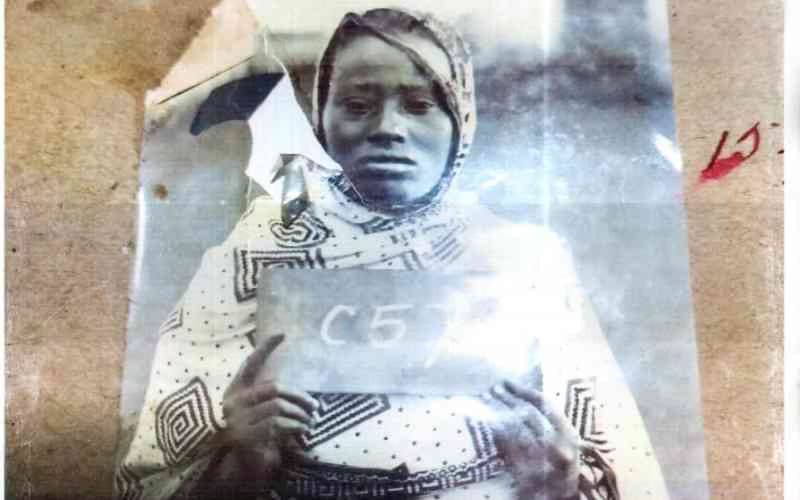
The recent rediscovery of Mekatili wa Menza’s image—from colonial files—provides an opportunity to think with how women are represented across Kenyan history. I am mostly interested in the artistic rather than political sense of representation, to the extent that the two can be distinguished. The unfocused image shows a beautiful woman—the gorgeous cheekbones, the abundant lips, the intense eyes, a sculptural face—even given the image’s blurry focus. The image surprises me.
In conversation with a friend, we talked about how images of past people—those we call ancestors and elders—often carry the patina of old (think of how often they appear in shades of grey and brown, the sepianess of it all). Those people—Mekatilili, Waiyaki, Lenana, Wanga, Syokimau—always read as old. The history books mark them as old through their dress and posture, through generic facial expressions meant to convey wisdom or struggle or both, through the items that surround them—the thatched hut, the manyatta, the clay pots, the three-legged stools, the wood fires, the clothes made of skin. The images tend to have a greyish cast, or perhaps it is simply that they were printed on cheap paper. We are not encouraged to think of them as having been young and desirable.
In Mekatili’s case, we know she gathered people by dancing the kifudu, a dance usually reserved for funerals, out of season. We might revise that statement to say that she recognized colonialism created an ongoing state of dying that required an ongoing funeral, so she danced to gather people in a state of collective grief, but not only grief. I can do no better than to cite the title of Douglas Crimp’s article: mourning and militancy. She gathered people in mourning and militancy.
I deviate.
What if she gathered people by expanding the geo-affective range of the kifudu and also because she was a beautiful woman. How might we think of her beauty as part of an anticolonial history? If we say people were attracted to her, can we include the libidinal alongside the spiritual and political? What might doing that enable for how we think of historical women as full humans, rather than as asexual icons?1
*
I had meant to start elsewhere.
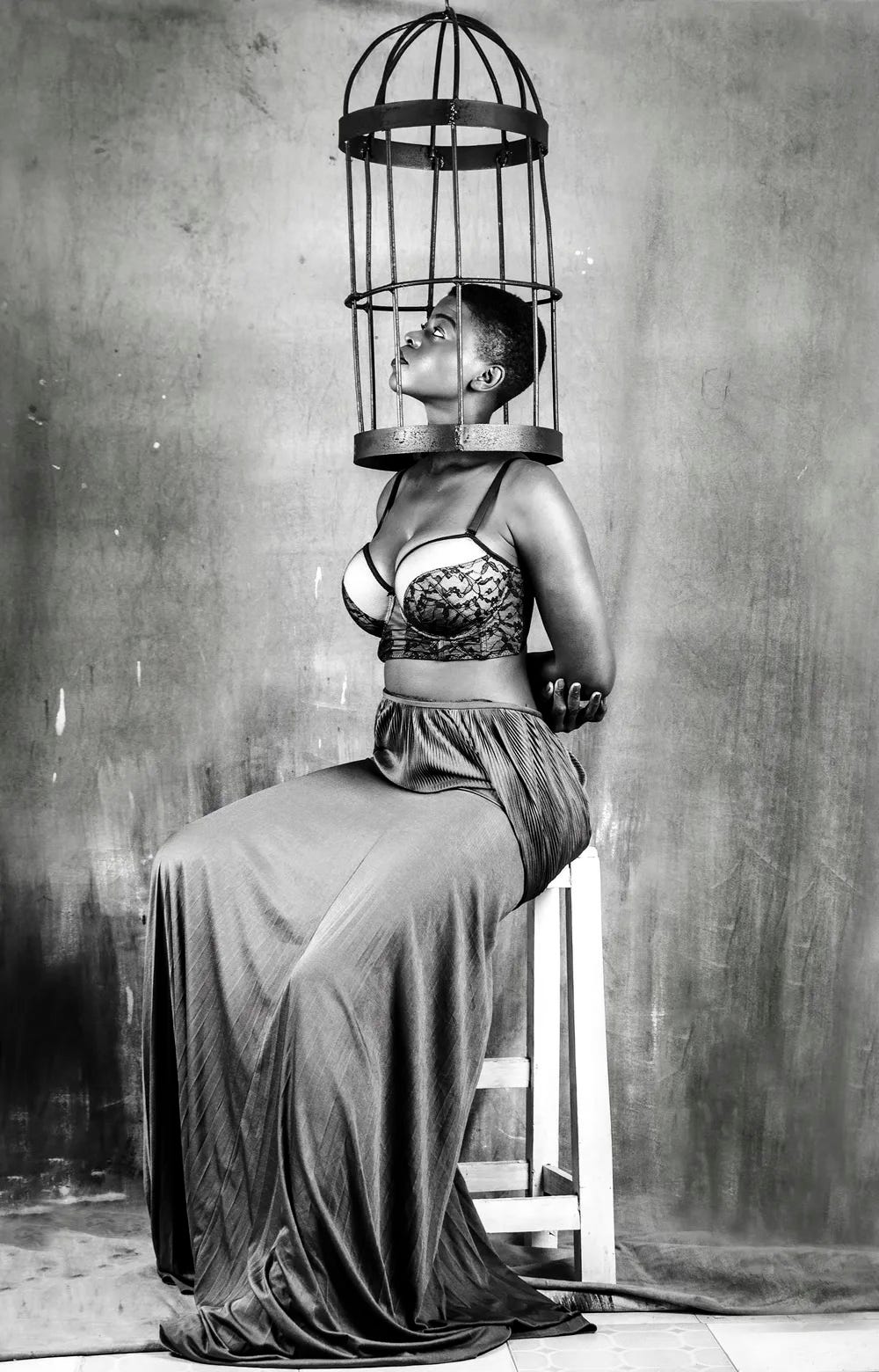
At Circle Art Gallery, I was intrigued by Sherie Margaret Ngigi’s In My Cage (2018).
Let me say, again, that I do not know what makes certain images arresting. What compels the eye to rest on them, the mind to dwell on them, the imagination to build worlds around them, the critical faculty to sit with them.
In My Cage invokes ownership and complicity (“my”); safety and refuge (one might withdraw into a cage to escape harm); kink (cages as part of erotic practices); social and cultural constraint (the categories of woman and female are often generated through practices of containment). I am fascinated by all these meanings, by what the “my” claims and is forced to claim. Even as there are questions of what the cage holds and what it cannot contain: an encased head, with open bars, so eyes can observe and ears can hear and a mouth might speak, still a sense of a trapped mental state. How does one see or speak through bars? And how might we think with the particular form of the bird cage?
Is it Adrienne Rich who writes about being “trapped” in “their imagination”? I wonder how the model who posed for this image experienced the process?
How might we think of this image as straddling multiple worlds: the aesthetic world of photography; the commercial world of fashion; the pleasure world of kink; and the feminist world of critique. How does assembling all of these worlds create multiple positions for a subject framed as woman? Questions I have. The answers are not quite as important. For now.
To be anachronistic, I wonder if In My Cage permits us to return to Mekatilili’s image, to see the containment—the frame of the photograph, the board holding a prisoner number, what looks like a mirror behind her that further frames and encloses—and to see what escapes containment. To see containment and its failure. We know about the failure because of history. We know of the failure because even today we continue to say her name, to revere her as a freedom fighter, and to learn from her practice how we, too, can refuse strategies of containment.
Perhaps I’m offering the banal claim that aesthetic works return us to history differently, with different urges and ambitions, different narrative desires and claims, different erotic practices and socialities, different demands and dreams. Christina Sharpe often uses the term “thinking juxtapositionally” to invite us to frame and reframe what we see and think we know by viewing not simply from another angle, but in conversation with something else. We think juxtapositionally to learn how to unsee the familiar and to create connections.
In Margaret Ngigi’s image, the model gazes upward. I’d love to imagine that she looks across history at Mekatili’s image and that in that glance, something happens.
I continue to learn from Jessica Marie Johnson’s and Treva Lindsey’s wonderful article on Harriet Tubman as a desiring, libidinal figure.